
How to Optimize UAE Tax Planning for Maximum Savings

Updated: Aug 25

Complex tax rules in the United Arab Emirates can feel overwhelming for even the most experienced executives and investors. As regulations shift, understanding your financial structure and identifying available tax incentives becomes more important than ever. This guide explains how a thorough Corporate Tax Impact Assessment can uncover potential liabilities, highlight optimization opportunities, and support sustainable wealth across every stage of your planning process.
Table of Contents
Quick Summary
Key Point | Explanation |
1. Assess Financial Structure Thoroughly | Conduct a comprehensive evaluation of your current financial landscape to identify liabilities and optimization opportunities. |
2. Identify UAE Tax Incentives | Understand the available tax incentives and exemptions to strategically minimize your tax liability and enhance financial efficiency. |
3. Tailor Corporate Strategies | Implement specific tax-efficient structures and strategies that align with the UAE’s tax landscape for optimal financial benefits. |
4. Monitor Compliance Regularly | Stay informed about regulatory updates and ensure compliance to avoid penalties and optimize financial performance. |
5. Evaluate and Adapt Planning | Regularly review tax planning outcomes and adjust strategies based on performance metrics to maintain financial effectiveness. |
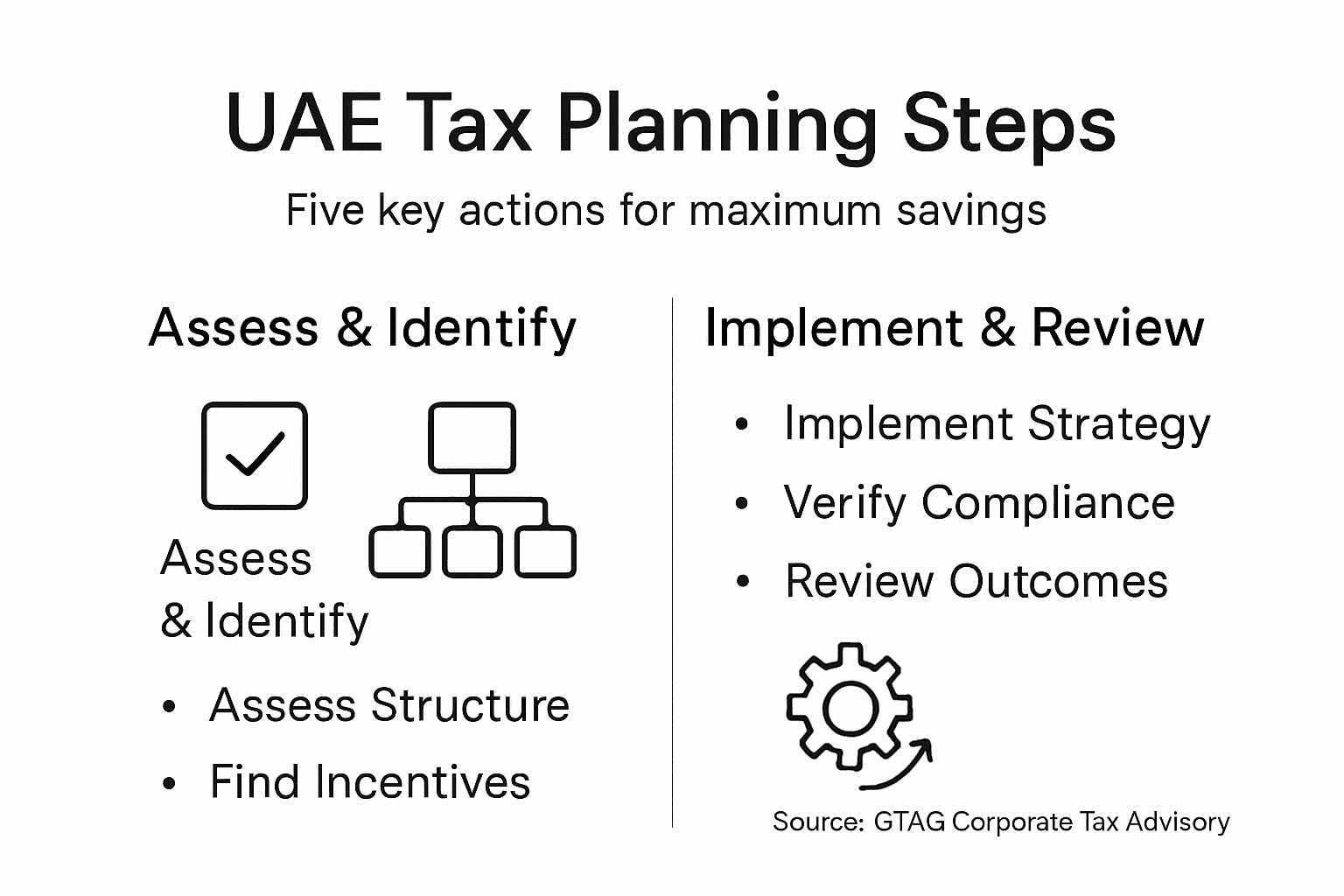
Step 1: Assess current financial structure and tax exposure
Assessing your current financial structure and tax exposure is a critical first step in optimizing UAE tax planning. This comprehensive evaluation will help you understand potential liabilities, identify optimization opportunities, and ensure compliance with the latest tax regulations.
Start by conducting a thorough Corporate Tax Impact Assessment that provides a 360-degree analysis of your financial landscape. This process involves examining several key components:
Review legal entity structures
Analyze current operational models
Evaluate existing financial documentation
Assess potential tax liabilities
Identify potential restructuring opportunities
Your assessment should dive deep into each business unit and financial stream. Gather all relevant financial documents, including balance sheets, income statements, tax returns, and corporate organizational charts. Pay special attention to:
Total revenue across different business segments
Profit margins for each operational unit
Current corporate legal structures
International transactions and cross-border financial flows
Existing tax arrangements and previous filing histories
A comprehensive assessment now can save significant money and prevent potential compliance issues later.
Consider engaging a professional tax advisor who specializes in UAE corporate tax regulations to ensure a comprehensive and accurate review. They can provide nuanced insights into potential optimization strategies specific to your business model.
Pro tip: Keep digital copies of all financial documents organized and easily accessible for smooth tax planning and potential future audits.
Step 2: Identify available UAE tax incentives and exemptions
Identifying available tax incentives and exemptions is crucial for maximizing your financial efficiency in the UAE. By understanding the nuanced landscape of tax benefits, you can strategically position your business to minimize tax liability and optimize your overall financial strategy.
Start by carefully examining the UAE Corporate Tax framework which offers several key incentives for businesses. The most notable opportunities include:
Zero tax on income under AED 375,000
Special treatments for Free Zone businesses
Targeted deductions for specific business activities
Exemptions for qualifying small and medium enterprises
Incentives designed to encourage strategic investments
Pay close attention to the specific compliance requirements for each incentive. Free Zone entities, for instance, must meet stringent regulatory conditions to maintain their tax-advantaged status. Critical factors to consider include:
Total annual revenue thresholds
Nature of business activities
Operational structure and legal entity type
Compliance with reporting and documentation standards
Maintenance of proper financial records
Strategic tax planning can transform potential liabilities into significant savings opportunities.
Consider working with a specialized tax advisor who understands the intricate details of UAE tax regulations. They can help you navigate the complex landscape and identify incentives most applicable to your specific business model.
Pro tip: Maintain meticulous documentation of all financial transactions and corporate activities to substantiate your eligibility for tax incentives.
Below is a quick comparison of UAE Mainland vs. Free Zone tax environments for businesses:
Aspect | Mainland Business | Free Zone Entity |
Corporate Tax | Standard tax rates | Preferential rates if compliant |
Regulatory Focus | Broad, less specialized | Industry-clustered, specialized |
Compliance Rules | General UAE standards | Additional Free Zone requirements |
Incentive Access | Limited | Broader, zone-specific |
Step 3: Implement tailored corporate and wealth strategies
Implementing tailored corporate and wealth strategies requires a sophisticated approach that aligns your financial structure with the UAE’s complex tax landscape. Your goal is to create a comprehensive plan that minimizes tax liability while maximizing financial efficiency.
Begin by exploring tax-efficient company structures that optimize your financial positioning. This involves several critical strategic considerations:
Analyze legal entity options
Evaluate Free Zone incentive opportunities
Design strategic transfer pricing policies
Implement wealth preservation tactics
Develop comprehensive financial planning approaches
Your implementation strategy should focus on creating a robust framework that addresses multiple financial dimensions. Consider these key steps:
Select the most appropriate business entity type
Map out international transaction structures
Develop comprehensive transfer pricing documentation
Create multiple income streams across strategic locations
Establish clear wealth management protocols
Strategic structuring can transform potential tax challenges into significant financial advantages.
Work closely with tax professionals who specialize in UAE regulations. They can help you navigate the nuanced landscape of corporate taxation and develop a customized strategy that reflects your specific business model and financial goals.

Pro tip: Regularly review and adjust your corporate structure to ensure continued alignment with evolving UAE tax regulations and your business objectives.
Here’s a summary of common UAE tax planning challenges and effective solutions:
Challenge | Potential Impact | Effective Solution |
Complex legal entity structures | Increased compliance risks | Conduct professional structure review |
Keeping up with regulation | Missed incentives, penalties | Set up real-time monitoring systems |
Managing international flows | Unexpected tax liabilities | Document and review transactions |
Qualifying for incentives | Lost tax savings | Ensure strict documentation |
Aligning structure with goals | Reduced financial efficiency | Adjust strategies regularly |
Step 4: Verify compliance and monitor regulatory updates
Verifying compliance and monitoring regulatory updates is a critical aspect of maintaining your tax strategy in the UAE’s dynamic financial environment. Staying ahead of legislative changes can mean the difference between optimal financial performance and potential penalties.
Carefully review key considerations for UAE tax compliance to ensure your business remains fully compliant. This involves a comprehensive approach that includes:
Track legislative amendments
Understand tax residency rules
Monitor transfer pricing regulations
Assess Economic Substance Requirements
Maintain accurate tax reporting systems
Develop a systematic approach to regulatory monitoring by implementing these essential steps:
Subscribe to official UAE tax authority newsletters
Schedule quarterly compliance reviews
Establish a dedicated compliance tracking system
Conduct regular internal audits
Maintain open communication with tax advisors
Proactive compliance is your best defense against potential regulatory challenges.
Consider creating a dedicated compliance team or working with specialized consultants who can provide real-time insights into regulatory changes. This approach ensures you’re always one step ahead of potential compliance issues and can quickly adapt your financial strategies.
Pro tip: Create a digital compliance dashboard that aggregates regulatory updates, tax changes, and key compliance deadlines to streamline your monitoring process.
Step 5: Evaluate outcomes and adjust planning as needed
Evaluating the outcomes of your tax planning strategy is crucial for ensuring continued financial optimization in the UAE’s dynamic business landscape. This final step allows you to measure the effectiveness of your implemented strategies and make data-driven adjustments.
Conduct a comprehensive performance review that examines multiple dimensions of your tax planning approach. This involves:
Analyze tax savings achieved
Compare actual versus projected outcomes
Assess compliance performance
Review financial efficiency metrics
Identify potential improvement areas
Implement a systematic evaluation process through these key steps:
Gather comprehensive financial data
Calculate total tax savings and efficiency gains
Benchmark against industry standards
Identify potential optimization opportunities
Document insights for future strategy refinement
Strategic adaptation is the key to sustained financial success in a rapidly changing regulatory environment.
Remain flexible and open to recalibrating your approach based on empirical evidence. Tax planning is not a one-time event but a continuous process of refinement and strategic adjustment.
Pro tip: Create a quarterly review framework with predefined metrics and triggers that automatically signal when strategic tax planning adjustments are necessary.
Unlock Your Maximum UAE Tax Savings with Expert Guidance
Navigating the complexities of UAE tax planning requires more than basic knowledge. This article highlights key challenges such as assessing your financial structure, identifying tax incentives, and maintaining compliance amid evolving regulations. If you want to avoid costly pitfalls and capitalize on every available saving opportunity, you need a trusted partner who understands your unique situation and can tailor solutions precisely to your needs.
At GTAG, our award-winning team specializes in corporate tax advisory, wealth optimization, and regulatory compliance to help businesses and high-net-worth individuals thrive in the UAE’s dynamic financial landscape. We combine deep expertise in tax structuring, asset protection, and financial planning to deliver insightful, personalized strategies that generate real results.
Take control of your financial future today by partnering with GTAG. Visit our official website to learn how our comprehensive services in tax, accounting, and wealth management can transform your approach to UAE tax planning. Explore our tailored solutions designed to maximize savings and secure lasting growth. Reach out now—your optimized tax strategy starts here.
Frequently Asked Questions
How can I assess my current financial structure for optimizing UAE tax planning?
To assess your current financial structure, conduct a Corporate Tax Impact Assessment that involves reviewing legal entity structures, operational models, and potential tax liabilities. Gather financial documents such as balance sheets and tax returns to get a clear picture of your financial landscape within 30 days.
What UAE tax incentives should I be aware of to maximize savings?
Key UAE tax incentives include zero tax on income under AED 375,000 and specific benefits for Free Zone businesses. Identify applicable incentives based on your business activities and compliance requirements to potentially reduce tax liabilities by up to 20%.
How can I implement tailored corporate strategies for tax efficiency?
Begin by exploring tax-efficient company structures and strategic transfer pricing policies tailored to your specific business model. Create multiple income streams across different locations to strengthen your financial position within 60 days.
What steps should I take to ensure compliance with UAE tax regulations?
To ensure compliance, track legislative amendments and understand the requirements for tax residency and transfer pricing regulations. Establish a dedicated compliance tracking system and conduct quarterly reviews to maintain adherence.
How do I evaluate the effectiveness of my tax planning strategy over time?
Evaluate your tax planning strategy by analyzing tax savings, comparing actual outcomes against projections, and reviewing compliance performance. Conduct this evaluation quarterly to identify areas for continuous improvement and potential additional savings opportunities.
Recommended


Comments