
UAE Accounting Standards Explained: Key Compliance Insights
- Digitalspace dive
- Feb 16
- 8 min read


Complex accounting frameworks can challenge even the most experienced finance teams in the United Arab Emirates. Understanding how international accounting standards define compliance and influence financial outcomes is critical for companies that want to compete on a global stage. Whether your organization operates under conventional or Islamic financial principles, gaining clarity on the UAE’s dual accounting approach will empower you to strengthen financial reporting and meet the expectations of regulators and stakeholders.
Table of Contents
Key Takeaways
Point | Details |
Alignment with International Standards | UAE accounting standards prioritize the adoption of International Financial Reporting Standards (IFRS) for transparent financial reporting. |
Regulatory Compliance | Companies must adhere to the UAE Commercial Companies Law and understand multiple regulatory frameworks for effective governance. |
Islamic Financial Standards | A unique dual-standard approach is in place, integrating IFRS with AAOIFI guidelines for Islamic financial institutions. |
Continuous Professional Development | Ongoing training and proper documentation are crucial for navigating compliance risks and maintaining financial integrity. |
Core Principles of UAE Accounting Standards
The United Arab Emirates (UAE) has developed a sophisticated approach to accounting standards that prioritizes international alignment and financial transparency. Companies operating within the UAE must adhere to a robust framework that combines international best practices with local regulatory requirements. International accounting standards play a critical role in shaping the financial reporting landscape.
The core principles of UAE accounting standards revolve around several key elements that ensure comprehensive and reliable financial reporting:
Alignment with International Standards: Complete adoption of International Financial Reporting Standards (IFRS)
Comprehensive Coverage: Encompassing financial reporting for both conventional and Islamic financial institutions
Regulatory Compliance: Strict adherence to UAE Commercial Companies Law
Transparency: Emphasis on clear, consistent financial disclosures
Specifically, the UAE has implemented a unique dual-standard approach that recognizes both international accounting principles and Islamic financial standards. Islamic accounting principles are particularly important for financial institutions operating under Shari’ah law, creating a nuanced and flexible reporting environment.
Companies must navigate a complex landscape that requires understanding multiple regulatory frameworks. The primary standards include IFRS requirements and AAOIFI (Accounting and Auditing Organization for Islamic Financial Institutions) guidelines, which together create a comprehensive accounting ecosystem.
Pro tip: Consult with a local accounting professional who understands both IFRS and AAOIFI standards to ensure complete compliance with UAE accounting regulations.
Types of UAE Accounting Frameworks
The United Arab Emirates has established a sophisticated and nuanced approach to accounting frameworks that cater to diverse business environments. International accounting standards play a critical role in shaping the financial reporting landscape across different sectors and organizational types.
The primary accounting frameworks in the UAE can be categorized into two main types:
International Financial Reporting Standards (IFRS): Applicable for most listed companies and public entities
Accounting and Auditing Organization for Islamic Financial Institutions (AAOIFI): Designed specifically for Islamic financial institutions
UAE Commercial Companies Law: Provides overarching regulatory guidance
SME-Specific Reporting Standards: Tailored guidelines for small and medium enterprises
Each framework serves a unique purpose in the UAE’s financial ecosystem. IFRS provides comprehensive global standards for financial reporting, while AAOIFI standards address the specific requirements of Islamic financial institutions operating under Shari’ah principles. Academic research on accounting frameworks highlights the complexity of selecting appropriate standards based on organizational needs.

Companies must carefully evaluate their sector, regulatory requirements, and operational context to determine the most suitable accounting framework. The flexibility of the UAE’s approach allows businesses to maintain international compliance while respecting local regulatory nuances.
Pro tip: Consult with a certified UAE accounting professional to determine the most appropriate accounting framework for your specific business structure and industry.
The following table summarizes the similarities and differences between the main UAE accounting frameworks:
Framework | Scope of Application | Key Focus Areas | Typical Users |
IFRS | Global financial reporting | Standardized disclosures, transparency | Public companies, large enterprises |
AAOIFI | Islamic financial institutions | Shari’ah compliance, ethical finance | Banks, insurance under Islamic law |
UAE Commercial Companies Law | Domestic regulatory oversight | Statutory compliance, governance | All registered UAE companies |
SME Standards | Small and medium enterprises | Simplified reporting, cost-effectiveness | Startups, small businesses |
IFRS Implementation and Reporting Requirements
The United Arab Emirates has established a comprehensive approach to IFRS implementation that mandates strict compliance for businesses across various sectors. The Commercial Companies Law No 2 of 2015 serves as the cornerstone of financial reporting standards, requiring companies to adopt international accounting practices with precision and transparency.
Key reporting requirements for IFRS implementation in the UAE include:
Full Financial Statement Preparation: Comprehensive reporting using IFRS standards
Regulatory Compliance: Adherence to UAE Commercial Companies Law
Exchange-Specific Requirements: Specific rules for NASDAQ Dubai, ADX, and DFS Authority markets
Transparent Disclosure: Detailed financial information reporting
Mandatory Reporting Mechanisms are critical for companies operating in the UAE. Reporting standards emphasize complete transparency and comparability of financial information across different entities. Public companies, particularly those listed on major exchanges, must prepare exhaustive financial statements that meet international accounting benchmarks.
The implementation process requires meticulous attention to detail. Companies must invest in robust accounting systems, train financial personnel in IFRS methodologies, and develop comprehensive internal reporting frameworks that align with international best practices. This approach ensures not just compliance, but also enhances the overall financial credibility of UAE-based organizations.
Pro tip: Engage specialized IFRS consultants to conduct a comprehensive gap analysis of your current financial reporting system before full implementation.
Legal Oversight and Regulatory Bodies
The United Arab Emirates has established a comprehensive network of regulatory oversight bodies responsible for maintaining financial reporting integrity and ensuring compliance across various financial sectors. Unlike many countries, the UAE does not maintain a separate national accounting standards body, instead relying on international frameworks and specialized market regulators.
Key regulatory bodies in the UAE financial landscape include:
UAE Accountants and Auditors Association (UAE-AAA): Primary professional body for accounting professionals
NASDAQ Dubai: Market regulator with specific financial reporting requirements
Dubai Financial Services Authority (DFSA): Comprehensive financial services oversight
Abu Dhabi Securities Exchange: Regulatory authority for securities market
Ministry of Economy: Overarching government oversight
Enforcement Mechanisms play a critical role in maintaining financial transparency. These regulatory bodies collaborate to ensure that companies adhere to international accounting standards, with each institution focusing on specific aspects of financial reporting and corporate governance. The UAE-AAA serves a particularly important function by recommending accounting standards to legislative authorities and maintaining professional standards for accountants and auditors.
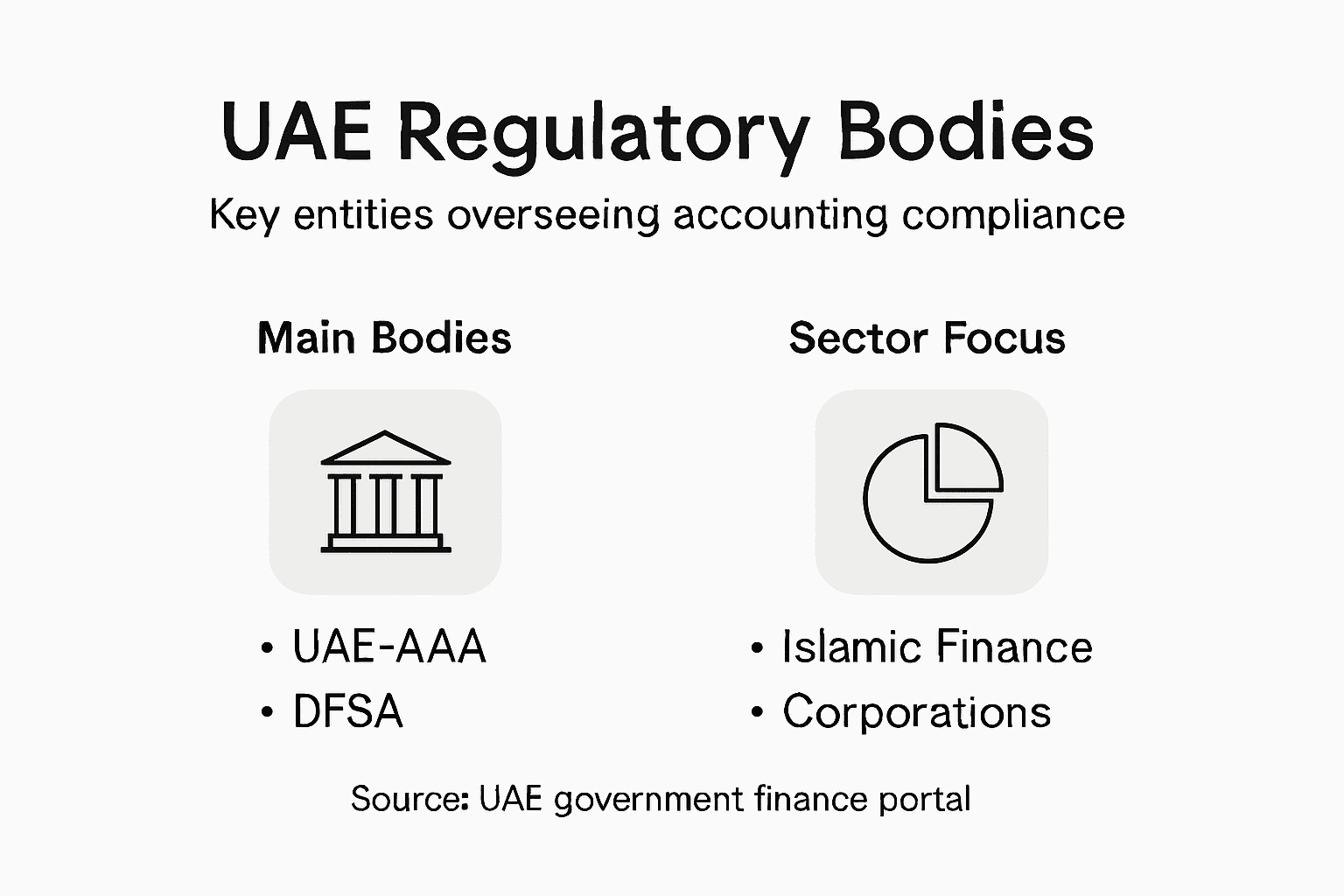
The regulatory framework is designed to be flexible yet rigorous, allowing businesses to operate within internationally recognized standards while maintaining the unique economic characteristics of the UAE. Companies must navigate these regulatory requirements carefully, understanding the specific mandates of each oversight body and their respective jurisdictions.
Pro tip: Maintain open communication channels with relevant regulatory bodies and conduct regular internal compliance audits to stay ahead of potential regulatory changes.
Here’s a quick reference to the leading UAE financial regulatory bodies and their primary roles:
Regulatory Body | Main Role | Sector Focus |
UAE-AAA | Professional standards, guidance | General accounting and audit |
DFSA | Financial services oversight | Banking and capital markets |
NASDAQ Dubai | Exchange regulation, compliance | Public securities market |
Abu Dhabi Securities Exchange | Securities supervision | Equity, bond markets |
Ministry of Economy | Economic policy, oversight | All business sectors |
Common Pitfalls in UAE Compliance
Navigating the complex landscape of financial reporting in the UAE requires a nuanced understanding of potential compliance challenges. Accounting standard implementation presents multiple potential risks that can trap even experienced financial professionals.
Critical compliance pitfalls include:
Limited Standard Knowledge: Insufficient understanding of specialized accounting frameworks
Training Gaps: Inadequate professional development in complex reporting requirements
Documentation Challenges: Incomplete record-keeping and insufficient audit trails
Regulatory Complexity: Navigating multiple overlapping regulatory requirements
Transfer Pricing Compliance represents another significant area of potential risk. Complex compliance requirements surrounding related party transactions demand meticulous documentation and precise valuation methodologies. Companies must ensure that all intercompany transactions adhere to arm’s length principles, maintaining comprehensive records that can withstand potential regulatory scrutiny.
The financial landscape in the UAE requires businesses to maintain exceptional diligence. Islamic financial institutions face additional complexity, with unique accounting standards that demand specialized knowledge and extensive training. Regulatory penalties for non-compliance can be substantial, making proactive risk management essential for financial sustainability.
Pro tip: Invest in continuous professional training and maintain robust documentation systems to mitigate compliance risks before they become critical issues.
Financial Implications for Corporations
Corporations operating in the UAE must navigate a complex financial landscape that demands strategic understanding of international reporting standards. Compliance with these standards directly impacts a company’s financial positioning, investor perception, and access to capital markets.
Key financial implications include:
Capital Market Access: Enhanced transparency increases international investment potential
Valuation Impact: Precise financial reporting influences company market valuation
Investor Confidence: Demonstrates commitment to global financial best practices
Risk Management: Provides clearer financial risk assessment mechanisms
Competitive Positioning: Signals operational sophistication to global stakeholders
Economic Environment Considerations play a critical role in corporate financial strategies. Economic growth dynamics in the UAE create both opportunities and challenges for corporations. External factors such as geopolitical tensions and commodity price fluctuations can significantly impact financial planning and risk management approaches.
The financial reporting framework in the UAE requires corporations to invest continuously in upgrading their financial systems, training personnel, and maintaining rigorous documentation standards. This ongoing commitment ensures not just compliance, but also positions companies to leverage international business opportunities effectively.
Pro tip: Develop a comprehensive financial reporting strategy that anticipates regulatory changes and invests in continuous staff training and technological upgrades.
Simplify UAE Accounting Standards Compliance with Expert Guidance
Navigating the complex UAE accounting standards such as IFRS and AAOIFI while ensuring full regulatory compliance can be overwhelming. Companies face challenges like understanding multiple frameworks, maintaining transparent disclosures, and managing transfer pricing documentation. Without expert advice and strategic financial planning, these obstacles can lead to costly compliance risks and missed growth opportunities.
GTAG specializes in providing tailored tax, accounting, and financial advisory solutions designed to help businesses and high-net-worth individuals confidently meet UAE financial reporting requirements. Our team of highly qualified professionals brings deep expertise in UAE Commercial Companies Law, Islamic accounting principles, and international reporting standards. We support you through IFRS implementation, risk management, and ongoing compliance strategies to protect your assets and enhance your financial positioning.
Take control of your financial reporting with trusted advisors who understand the nuances of the UAE market. Visit GTAG to learn how our comprehensive services including outsourced accounting and CFO advisory can simplify your compliance journey.

Ready to protect your business from costly pitfalls in UAE financial compliance? Partner with GTAG today to transform complexity into confidence. Start now by exploring our expert solutions at GTAG and securing your financial future.
Frequently Asked Questions
What are the core principles of UAE accounting standards?
The core principles include alignment with international standards, comprehensive coverage of both conventional and Islamic financial reporting, strict regulatory compliance, and an emphasis on transparency in financial disclosures.
How do IFRS and AAOIFI standards differ in the UAE?
IFRS is applicable to most listed companies and focuses on standardized financial reporting, while AAOIFI specifically caters to Islamic financial institutions, emphasizing Shari’ah compliance and ethical finance practices.
What are some common compliance challenges businesses face in the UAE?
Common challenges include limited knowledge of accounting standards, training gaps for staff, incomplete documentation, and the complexities of navigating multiple regulatory requirements.
How does compliance with UAE accounting standards impact financial reporting?
Compliance enhances capital market access, improves company valuation, boosts investor confidence, and provides clearer mechanisms for risk assessment, ultimately benefiting the firm’s competitive positioning.
Recommended
Comments